
black lotus
The story of a woman, that went from concubine, to pirate empress.

Illustration by Ben Singh
Before the Red Flag
There are places in the world where people learn things they never chose to learn.
She grew up in one of those places.
It stood along the Pearl River, where lantern light trembled on dark water and voices carried further at night than they ever should have. People came there to forget who they were. And in forgetting, they revealed more than they intended.
That is where she learned to listen.
Not the kind of listening that answers.
The other kind.
The kind where you disappear, and the truth comes looking for you.
At first, she believed beauty would be enough. Many girls did. It was what they were told.
But beauty fades quickly in a place where men do not come to admire, but to take.
What lasted was attention.
She noticed early that the girls who spoke too freely were corrected. Not always with words. The ones who were careful, who listened more than they spoke, seemed to last longer.
So she practiced.
She learned how to stand close enough to hear, but far enough to be forgotten.
How to lower her gaze without losing awareness.
How to let people believe she was not there at all.
And when they believed that, they told the truth.
She heard where money moved before it was counted.
She heard fear hiding inside laughter.
She heard men speak of power they did not have, and sometimes of power they did.
She learned something else too.
There is a moment when a man stops pretending.
It is small. Almost invisible. But once you hear it, you never mistake it again.
She learned to hear it.
Her name did not matter then. Names changed often in that place. They were given for convenience and taken just as easily.
So she did not hold on to it.
She held on to other things.
Faces.
Voices.
Details others ignored.
She could recognize a man even when the lanterns made him look like someone else.
She could feel the weight of coins and know if something was missing.
She knew when to look down, and when looking down would cost her something.
Most importantly, she remembered.
One evening, a man arrived who did not belong to the usual noise.
He did not raise his voice.
He did not laugh too loudly.
He did not look around to see who was watching him.
And that was how she knew people already feared him.
Men who need fear make sure it is seen.
Men who have it do not.
His name was Zheng Yi.
When he looked at her, she felt something unfamiliar.
Not desire.
Not dismissal.
Attention.
It was the same kind of attention she gave to others.
That unsettled her. He asked her questions.
Not kind ones. Not cruel ones. Just precise.
How many ships worked the river mouth.
Which officials could be bought.
Who cheated their partners, and who feared being cheated.
She considered lying. It would have been safer.
Or at least easier.
But lies are expensive. They must be remembered, protected, carried. Truth, when used carefully, costs less.
So she answered.
Not everything. Never everything. But enough.
He listened. Not like a man waiting to speak.
Like a man deciding what mattered.
When he asked her to come with him, he did not call it rescue. He called it work. She did not answer immediately.
Instead, she asked a question.
“On what terms?”
He paused. Only briefly, but she saw it.
So she continued.
What share of profit would be hers.
What protection she would have.
What would happen if he died.
Whether she would be used, dismissed, or heard.
Each question carried something she did not say aloud.
I will not disappear again.
Zheng Yi did not laugh. He answered.
And when his answers were not enough, he adjusted them. That was when she decided.
Not because she trusted him. But because she understood him.
The ship was louder than the house by the river. Men shouted constantly. Laughed loudly. Fought quickly.
At first, it seemed like chaos. But it was not. At the center of it stood Zheng Yi.
He did not shout.
He did not repeat himself.
He spoke once, and things happened.
When he punished, it was final.
No one wondered what he meant. No one asked twice.
And she understood something important.
Men did not follow him because they liked him.
They followed him because they knew exactly what would happen if they did not.
Predictability, she realized, was a form of power.
So she watched.
She listened to arguments and remembered who began them and who ended them.
She learned which captains obeyed, and which only pretended to.
She noticed resentment, the quiet kind that waits.
She learned where the fleet was strong. And where it would break.
The storm did not know who Zheng Yi was. It did not care. It came, and it took him. And just like that, everything shifted.
For a moment, there was silence. Then something else replaced it.
Not grief.
Something sharper.
She saw it in the way the men looked at her.
Not with sympathy.
With calculation.
A woman was not meant to remain here.
A widow was not meant to lead.
In that moment, the girl without a name was no longer enough.
Ching Shih understood immediately.
This was not a moment to feel. This was a moment to act. That night, she did not cry.
She began to work. She did not start with the strongest men. She started with the necessary ones.
The men who controlled food.
The men who kept records.
The ones who understood movement and supply.
Because power is rarely where it appears.
She asked questions. Simple ones.
But they revealed everything.
Who trusted whom.
Who feared whom.
Who had already chosen a side without saying it.
She did not force answers.
She waited. People reveal themselves when they believe they are safe.
By morning, the fleet was not united. But it was still. And stillness can be shaped.
When they tested her, she did not argue. She responded with structure.
With rules.
With consequences that followed action without hesitation.
When they challenged her, she did not raise her voice.
She made decisions. Clear ones. Final ones.
And when they underestimated her, she allowed it.
There is no need to interrupt a mistake.
Only to answer it.
She never said she was in control.
She did not need to.
Power gathered around Ching Shih slowly.
Like the weather. At first unnoticed. Then impossible to ignore.
Years later, men would write about her as if she had appeared suddenly. As if her rise had been unnatural.
They called it an exception. They were wrong.
There was nothing sudden about her.
She had been learning long before anyone thought to see her.
In quiet rooms.
In half-heard conversations.
In moments where survival depended on noticing what others ignored.
By the time she raised the red flag,
Ching Shih was not becoming something new.
She was simply allowing the world
to see what had already been there all along.
I. The Law of the Red Flag
The man had been kneeling long enough that his legs had gone numb. That worried him more than the blade.
If his body failed him before the sentence was spoken, it would look like weakness. Weakness invited improvisation, and improvisation was dangerous. He forced himself to breathe evenly and keep his back straight.
The charge was read slowly. Too slowly.
The words were familiar—every man in the fleet knew them by heart. Took a woman without leave. Disobeyed a direct order. Attempted to flee discipline. Each phrase landed like a weight he had already lifted a hundred times before, only now it was crushing instead of proving strength.
Ching Shih sat behind the table, hands folded, eyes lowered. She did not look at him while the accusations were read. That was worse than anger. Anger meant you were still being measured.
Someone—an officer who owed him favors—cleared his throat and spoke of the man’s years of service. Storms survived. Ships taken. Loyalty proven.
Ching Shih raised one finger.
The officer stopped mid-sentence.
She looked at the man then. Not with disgust. Not with pity. With attention.
“Did you know the law?” she asked.
“Yes.”
“Did you believe it would bend for you?”
He hesitated. That was the wrong answer, but the truth had already betrayed him.
She nodded once, as if confirming a calculation.
The order was given quietly. No announcement. No spectacle. The executioner stepped forward, efficient, almost bored.
As the blade fell, something passed through the watching crews—not fear, but a strange settling. The law had arrived on time. It had not been delayed by reputation. Tomorrow, every man would wake knowing exactly where the line stood.
That knowledge held the fleet together more tightly than loyalty ever could.
II. The Village Under the Red Flag
The elder had practiced his speech for three days. He did not use it.
The pirate harbor smelled of tar, salt, and something sweeter—spilled rice wine, perhaps. Ships pressed close together, their hulls scarred but maintained. This was not the chaos he had imagined.
He was brought before Ching Shih with no ceremony. No chains. No guards looming theatrically behind him.
She gestured for him to sit.
He placed the account book on the table, fingers lingering on its worn edge. “This,” he said, opening it, “is what the empire took from us last year.” He turned the pages slowly. Numbers written carefully, bitterly. “This is what they promised in return.”
She did not look at the book. She listened.
When he finished, she named a sum. Lower. Precise. She named a date when it would be collected, and who would collect it. She named the punishment if her men violated the agreement.
The elder hesitated. “And if another fleet—”
“They won’t,” she said. Not as a boast. As a statement of jurisdiction.
He searched her face, trying to find cruelty or hunger there. He found neither. Only attention.
He bowed, deeper than custom required.
Weeks later, when her flag rose over the harbor, the villagers waited for violence. None came. When a drunken pirate struck a fisherman, the pirate vanished before nightfall.
The empire never noticed the flag.
The villagers did.
III. The Sea That Refused to Fight
The first mistake was assuming the pirates wanted to be found.
Admiral Xu stood at the prow before dawn, watching mist peel back from the water in slow, indifferent layers. The charts said the Red Flag Fleet should have been here. The reports insisted on it. Fishermen swore they had seen the sails only days before.
Yet the sea lay empty.
By the third day, Xu began to feel the shape of the trap without understanding its mechanism. Ships burned oil to maintain formation. Rations were issued carefully, then more carefully still. The men whispered at night—not about the enemy, but about absence. About being watched.
On the sixth day, a scouting vessel failed to return.
Xu ordered pursuit anyway. Turning back would be seen as weakness, and weakness invited censure from Canton. He told himself the pirates were afraid. He told himself this was patience, not hesitation.
That night, one of the supply junks vanished. No wreckage. No signal. Just an accounting error that could not be corrected.
By the tenth day, sickness spread. The water stank. Arguments broke out over orders that contradicted yesterday’s orders. Xu began rewriting dispatches before sending them, stripping doubt from his own words.
On the twelfth night, a fire bloomed far off the port side—one of his own ships, taken silently, burning without resistance.
At dawn, pirate sails appeared at last. Not charging. Waiting.
Xu understood then. This had never been a battle meant to be won. It was a delay, stretched long enough for the empire to bleed itself dry.
Later, Xu would write that the pirates were cowards who avoided honorable engagement.
Ching Shih never corrected him.
IV. The Woman Who Walked Into Canton
They searched her for weapons twice.
Not because protocol demanded it, but because the guards could not believe what they were seeing. No escort. No armor. No defiance staged for effect.
Just a woman walking into Canton as if summoned.
Inside the hall, the officials sat stiff-backed, rehearsed expressions ready. They had prepared threats, clemency, moral lectures. They had prepared for a criminal.
They had not prepared for a negotiator.
Ching Shih listened longer than expected. Let them speak of order, of the empire’s patience, of punishment deferred. She let the room fill with its own importance.
Then she spoke.
She did not argue innocence. She did not beg mercy. She spoke of ships that would need feeding if the war continued, of sailors who would drift into banditry if not settled, of coasts that would burn not out of rebellion but neglect.
She spoke of numbers.
When one official threatened annihilation, she asked how many ships could be spared from other coasts. When another promised clemency, she asked what clemency was worth without enforcement.
The room shifted. Not in her favor — but out of certainty.
By the end, the agreement felt less like surrender than escape. The empire would stop bleeding. She would stop ruling.
When she left the hall unbound, no one watched her go.
Everyone pretended this had been mercy.
V. After the Storm, the Accounts
The gambling house smelled of sweat and incense and cheap wine. Ching Shih knew the smell well. She had chosen it.
She sat behind the counter, hands steady, eyes sharp. Dice rolled across the table. Men cursed luck as if it were a traitor rather than a habit. Coins passed through her fingers, counted once, then again.
No one recognized her.
That anonymity was not accidental. It was the final discipline she imposed on herself.
Sometimes she heard her name spoken, distorted by rumor. A woman who commanded a thousand ships. A demon. A myth. The men laughed at these stories, arguing details she knew were wrong.
She did not correct them.
At night, she locked the doors herself. She slept without guards. Without dreams.
The empire never came for her. It watched instead, uncertain whether disturbing her would invite a return of things better left buried.
When she died, there was no reckoning waiting. No punishment delayed.
She had already balanced the accounts.
The sea still moved. The empire still stood.
She had outlived them both.
Bring this story home.
Do you wish to hold your favourite story in your hands
or share them with someone special. Discover illustrated prints, story booklets, and t-shirts

An A5 storyBooklet featuring the complete short story in print, on premium uncoated paper for a soft, book-like feel.
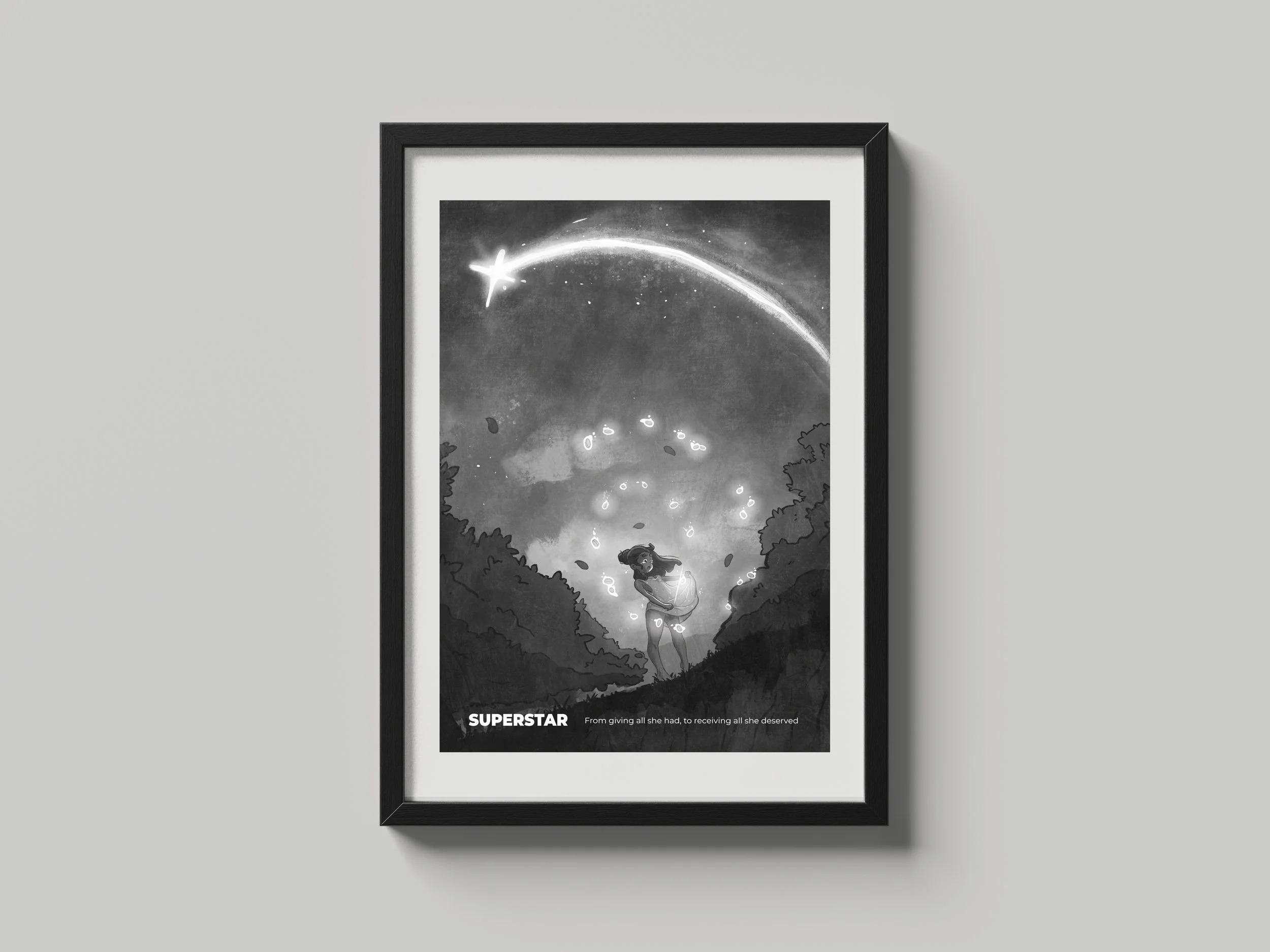
A2 StoryPoster printed on museum-grade matte paper for exceptional detail and lasting quality. The subtle texture enhances both text and illustration, making it as timeless as the story it tells.

A premium 100% organic cotton t-shirt featuring an original illustration and short story. Printed with eco-friendly inks for a soft, durable design.
Wear your story wherever you go.